
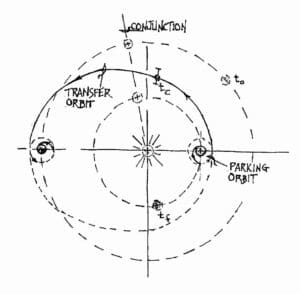
Earth and Mars are in separate orbital planes. They cross on the way to Mars. My algorithm had the spacecraft remain in Earth’s orbital plane until the planes intersect, then made a small mid-course correction to transfer onto Mars’ orbital plane.
This is an extremely nonlinear problem. The only way to “reach Mars” is to build a rough model and then use a genetic algorithm to find an actual solution. It’s even more difficult because Mars is going about 6000 MPH faster than the spacecraft as you approach. The genetic algorithm creates a dozen trajectories, selects the best one; then generates a dozen more based on that solution, chooses the best one; etcetera. There are other nonlinear optimization methods, but they all depend on iterative, statistical methods to solve your trajectory model.
I divided my Mars Pathfinder program into two problems, solved them separately, and then just patched them together. The starting point for both problems was the mid-point course correction where the orbital planes of Mars and Earth intersect. I integrated forward to Mars and backward in time to Earth.
Gravity is a central force, which means you can integrate the equations of motion backward in time if you have no other (non-central) forces in your model. That’s how astronomers study the evolution of the solar system, integrating current forces back through time.
My Mars algorithm generates a solution for every input without the need for plugging it into any other optimization method. However. Taking my program and using the genetic algorithm to integrate, for example, where it makes the thrusts and other variables, would make the result even more energy-efficient.